
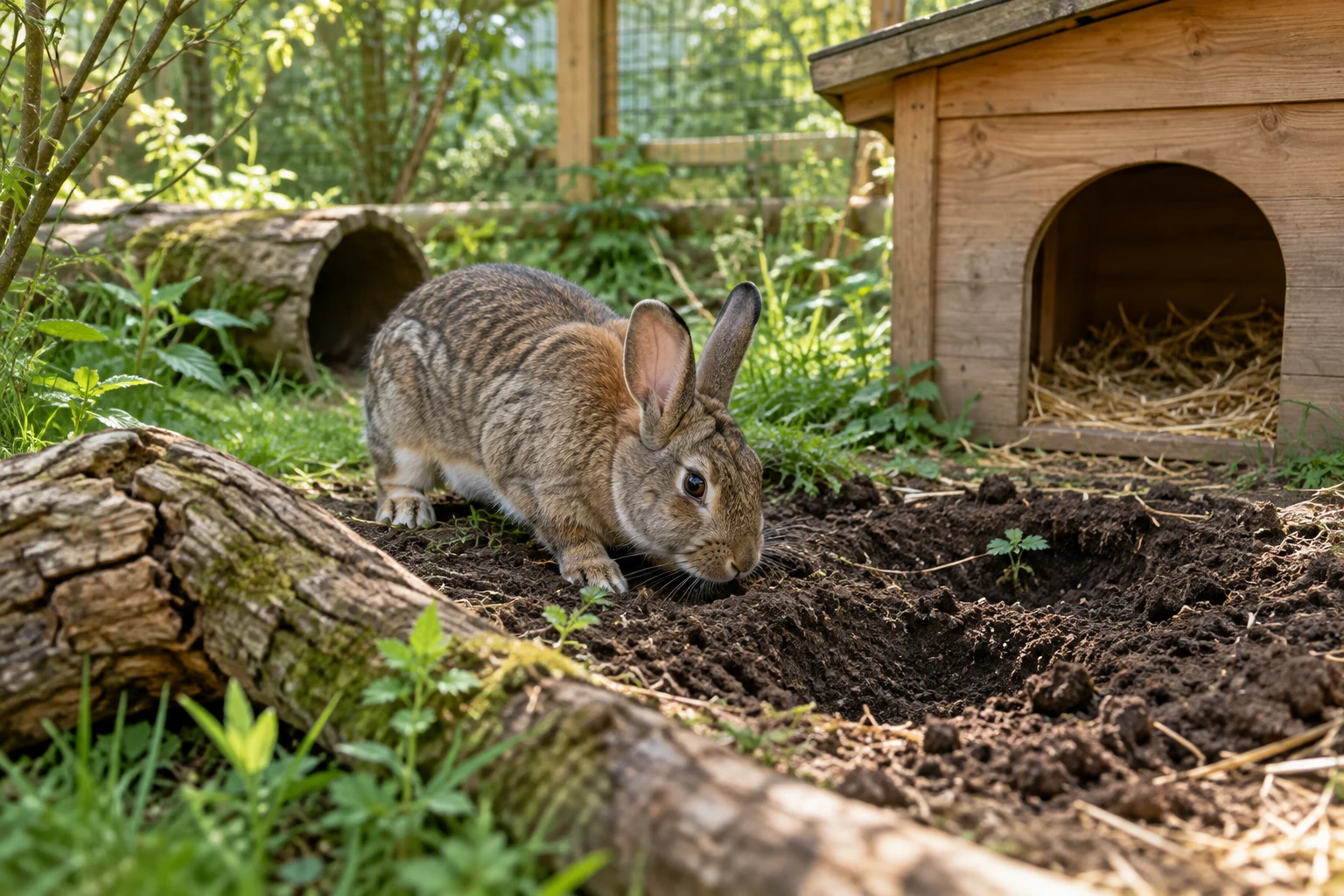
Natural behaviour refers broadly to activities associated with an animal's species and way of life, such as exploring, foraging, resting and appropriate social contact. Opportunities to perform important, rewarding behaviours can support welfare. However, naturalness alone does not prove that an animal is doing well: health, comfort, safety, individual preferences and the consequences of the behaviour also matter.
A rabbit digging beside a fence and a cat scratching a sofa may be doing things inconvenient to people but meaningful to them. Good care begins by asking what the activity provides, then finding a safe way to meet that need. Food and shelter are essential; they do not answer every question about how an animal experiences daily life.
What does “natural behaviour” actually mean?
The term usually describes behaviour connected with a species' biology and life in an appropriate environment. It is not a precise, universally agreed checklist of activities that every individual must perform.
Behaviour develops through interacting influences, including inherited tendencies, learning and circumstances. Domestication, age and individual experience can change how it is expressed. A domestic animal should not be expected to reproduce every activity of its wild ancestors.
For welfare, the useful questions are more specific: What does this animal value? What is it strongly motivated to do? Does the available environment permit comfortable, rewarding activity? Scientific assessment can examine preferences and what animals will work to obtain, alongside health and behaviour. A label such as “natural housing” is less informative than evidence about the animals living there. [1, 2]
Why are behavioural opportunities part of good welfare?
Animals can have needs beyond nutrition, water and protection from injury. Restricting important activities can create frustration, while suitable opportunities can allow positive experiences.
For example, providing a hen with food does not supply a place to dust-bathe or lay an egg. A furnished environment offers more ways to use the body and interact with surroundings than an otherwise similar barren one. Which opportunities matter, and how much, must be assessed for the species and individual. [1, 3]
The World Organisation for Animal Health includes the expression of normal patterns of behaviour in its animal-welfare guidance. RSPCA Australia similarly describes good welfare as including physical and mental states, with positive experiences as well as protection from suffering. Behavioural care belongs alongside medical care and suitable housing, rather than being an optional extra once those are complete. [4, 5]
Does every natural behaviour improve welfare?
No. Natural events and behaviours can involve fear, injury, disease or predation. Recreating them simply because they occur in the wild can cause harm.
A cat's hunting-related movements can be expressed through suitable play; allowing the cat to injure wildlife is not required to meet its behavioural needs. Similarly, an animal does not need food scarcity to make feeding more authentic. Care should provide opportunities the animal values while protecting it and other animals. [2, 6]
Nor does the presence of one desirable behaviour certify an entire environment. A hen may dust-bathe but still have another unmet need. Welfare assessment must consider the whole animal and the effects of its surroundings. “Natural” is a starting point for investigation, not a guarantee of a good life.
What do safe behavioural outlets look like?
A useful outlet lets the animal perform a meaningful activity without avoidable danger. It should be accessible, suitable for the species and adjusted to the individual's abilities.
| Animal | Behavioural opportunity | What makes the provision useful? |
|---|---|---|
| Cat | Scratching and hunting-related play | Suitable scratching surfaces and supervised toy play provide outlets within a safe home. |
| Rabbit | Digging and exploration | A secure digging area permits digging without allowing escape from the enclosure. |
| Hen | Dust-bathing, perching and nesting | Appropriate material and usable places support different activities rather than merely adding objects. |
These are examples, not complete care plans. A rabbit digging area cannot replace adequate space and compatible companionship; a scratching post cannot resolve every problem in a cat's environment. Consult species-specific veterinary or recognised welfare guidance before changing housing or introducing unfamiliar materials. [3, 6, 7]
Why do choice and individual differences matter?
An opportunity is more valuable when the animal can use it voluntarily and has reasonable alternatives. Being placed on a perch or pushed towards another animal is different from choosing to approach.
The Five Domains framework considers interactions with the environment, people and other animals in relation to mental experience. It encourages attention to rewarding choices, alongside reducing negative experiences. In everyday care, that means offering retreat as well as activity, and allowing rest without repeated disturbance. [8]
Age, mobility and temperament also matter. Some cats play more than others, and older cats may show different activity patterns. Adapt the opportunity rather than demanding an identical performance from every animal. The measure of success is its usefulness to the individual, not how impressive the equipment looks. [6]
What might suggest that behavioural needs are not being met?
Persistent frustration, difficulty accessing valued activities or abnormal repetitive behaviour warrant investigation. They should not be interpreted from appearance alone.
For instance, RSPCA Australia's pig-welfare guidance describes repetitive bar-biting and sham chewing in connection with inappropriate environments. This does not mean that every repetitive movement in every species has the same cause. Look at context, frequency and changes over time. [9]
Changes in behaviour may also involve pain or illness. If an animal becomes withdrawn, changes its usual activities or seems distressed, seek veterinary advice rather than assuming it only needs another toy. Health and behaviour are connected; an enrichment change is not a substitute for assessment. [10]
Practical Takeaway
Start with an important activity, not a product: what does this animal need or value doing? Provide a safe, accessible opportunity, allow choice and observe whether it is used comfortably. Review the animal's health and wider environment as well. Good behavioural care supports meaningful daily life without recreating the dangers of life in the wild.
Frequently Asked Questions
Do domesticated animals still have behavioural needs?
Yes. Domestication does not remove the need for appropriate behavioural opportunities. The relevant activities should reflect the present species and individual, rather than an idealised wild ancestor.
Is an animal with food and a clean enclosure necessarily content?
No. Those provisions are essential but may leave important behavioural or social needs unmet. Assess comfort, health and opportunities for rewarding interaction together.
Is outdoor living always better because it is more natural?
No. Location alone does not establish welfare. Safety, climate, health, usable space and behavioural opportunities all matter; appropriate arrangements differ by species and situation.
Does a behaviour I dislike mean my animal is misbehaving?
Not necessarily. Scratching or digging can be ordinary species-related activity. Understanding its function helps you provide an acceptable outlet and seek help if the behaviour changes or becomes problematic.
Can I force an animal to try enrichment?
Avoid forced participation. Offer suitable opportunities with retreat and alternatives. If an animal repeatedly avoids an activity, reconsider its suitability rather than treating avoidance as disobedience.
Sources
Source 1
Organisation / publisher: Bracke and Hopster; Journal of Agricultural and Environmental Ethics; Wageningen University & Research author record
Title: Assessing the Importance of Natural Behavior for Animal Welfare (2006)
URL: https://research.wur.nl/en/publications/assessing-the-importance-of-natural-behavior-for-animal-welfare/
Use: Author-hosted abstract on behavioural needs, motivation and assessing the importance of activities. Only the accessible abstract was used, not an unseen full paper.
Checked: 2 October 2026
Source 2
Organisation / publisher: Marian Stamp Dawkins; Animals; University of Oxford
Title: Natural Behaviour Is Not Enough: Farm Animal Welfare Needs Modern Answers to Tinbergen's Four Questions (2023)
URL: https://pmc.ncbi.nlm.nih.gov/articles/PMC10044334/
Use: Why naturalness alone cannot establish welfare; behavioural development and evidence about what animals value. Farm-animal discussion used as a conceptual argument, not a species-wide care protocol.
Checked: 2 October 2026
Source 3
Organisation / publisher: RSPCA England and Wales
Title: Chickens in the UK: Facts, Behaviour and Welfare
URL: https://www.rspca.org.uk/en/adviceandwelfare/farm/farmanimals/chickens
Use: Examples of hen dust-bathing, perching, nesting and appropriate environmental opportunities; no UK industry figures or farming rules generalised.
Checked: 2 October 2026
Source 4
Organisation / publisher: World Organisation for Animal Health (WOAH)
Title: Animal Welfare
URL: https://www.woah.org/en/what-we-do/animal-health-and-welfare/animal-welfare/
Use: International welfare guidance includes normal patterns of behaviour; no claim that international guidance is automatically domestic law.
Checked: 2 October 2026
Source 5
Organisation / publisher: RSPCA Australia
Title: Good Animal Welfare
URL: https://kb.rspca.org.au/categories/rspca-policy/purpose-vision-mission-and-values/good-animal-welfare
Use: Physical and mental welfare, safety and positive experiences beyond avoiding suffering.
Checked: 2 October 2026
Source 6
Organisation / publisher: Feline Veterinary Medical Association (FelineVMA)
Title: Setting Up the Environment for Success
URL: https://catvets.com/resource/setting-up-for-success/
Use: Normal feline scratching and hunting-related play; variation by life stage and individual; appropriate outlets.
Checked: 2 October 2026
Source 7
Organisation / publisher: RSPCA Australia
Title: Where Should I Keep My Rabbits?
URL: https://kb.rspca.org.au/categories/companion-animals/rabbits/where-should-i-keep-my-rabbits
Use: Rabbit digging opportunity alongside secure, appropriate housing.
Checked: 2 October 2026
Source 8
Organisation / publisher: RSPCA Australia
Title: What Are the Five Domains of Animal Welfare?
URL: https://kb.rspca.org.au/categories/about-animal-welfare/what-are-the-five-domains-of-animal-welfare
Use: Choice, rewarding interactions and positive experiences within a multidimensional welfare framework; not a diagnostic scoring system.
Checked: 2 October 2026
Source 9
Organisation / publisher: RSPCA Australia
Title: What Are the Animal Welfare Issues Associated With Pig Production?
URL: https://kb.rspca.org.au/categories/farmed-animals/pigs/what-are-the-animal-welfare-issues-associated-with-pig-production
Use: Restricted behavioural opportunities and abnormal repetitive behaviour in pigs. No Australian regulatory statements or measurements were used.
Checked: 2 October 2026
Source 10
Organisation / publisher: FelineVMA; Cat Friendly Homes
Title: Intercat Tension
URL: https://catfriendly.com/be-a-cat-friendly-caregiver/intercat-tension/
Use: Pain and illness can alter behaviour; need to consider medical explanations alongside environmental ones.
Checked: 2 October 2026
Questions or corrections? Contact Aniluba and include this page’s address.