
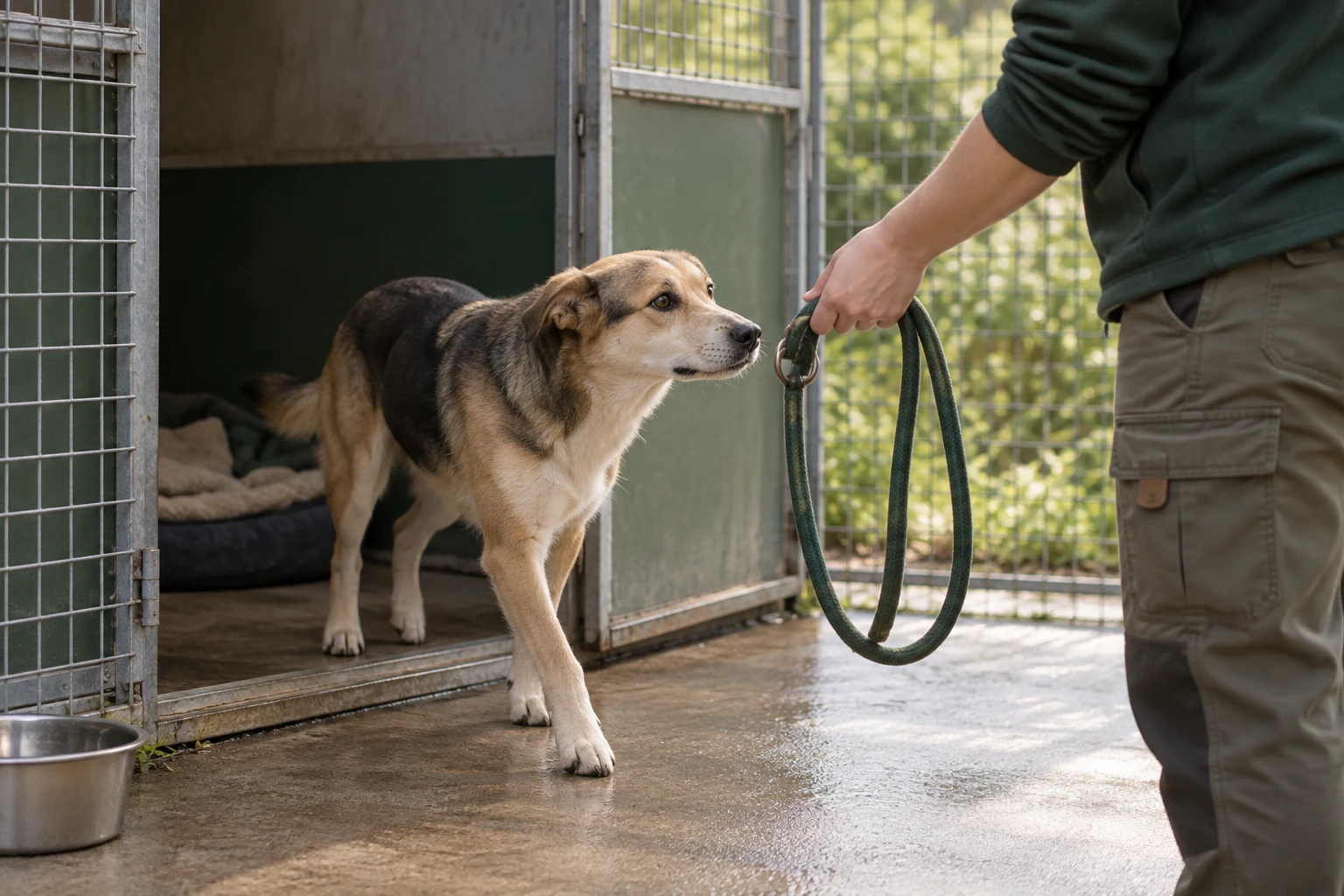
Shelters can reduce handling stress by training personnel to read species-appropriate body language, planning each task before contact, using suitable environments and equipment, and applying only the minimum restraint needed for necessary care. The handler should slow down, add distance or stop when fear escalates, unless delaying would create a greater emergency risk. High-risk or medical procedures need trained personnel, clear escalation routes and veterinary input where medication or sedation may be appropriate.
Handling happens throughout shelter care: intake, movement, cleaning, examination, treatment, exercise, introductions and transport. A humane system cannot depend on one experienced person’s instincts. It needs written protocols, practical training, accurate records and permission for personnel to pause when a plan is failing.
Low-stress handling is not simply “being gentle”. It is a risk-managed approach that considers what the animal is communicating, what the task requires and whether a safer route exists.
What does low-stress handling require before contact?
Start by defining the task. Moving a dog to an exercise area, weighing a cat and treating a painful wound require different people, equipment and levels of restraint. Check the animal’s record for medical pain, mobility limits, escape behaviour, previous handling responses and known rewards. Confirm where the animal is going and whether the route is clear.
Prepare equipment before opening an enclosure. Repeatedly leaving, returning and reaching into the animal’s space can increase arousal and create escape opportunities. The correct carrier, lead, barrier, towel, transfer enclosure or protective equipment should be available and in working order.
Personnel also need to know their limit. An unfamiliar, painful or highly fearful animal should not become an improvised training exercise for a new handler. The protocol should state who can manage higher-risk tasks and how help is summoned.
How should personnel read and respond to body language?
Training should cover the species and individuals the organisation actually houses. Personnel need to recognise early signs of discomfort as well as obvious threats. Relevant changes may include altered posture, weight shift, gaze, ear or tail position, facial tension, freezing, retreat, hiding, vocalisation, escape attempts, lunging or loss of interest in food.
No single signal proves an emotional state. Context and combinations matter. Stillness may mean the animal is coping, but it can also reflect fear or behavioural inhibition. A dog taking food is not necessarily comfortable, and a quiet cat is not necessarily safe to handle.
Respond early. Turn the body sideways, reduce direct reaching, lower noise, create distance, allow an exit or hiding option where safe, or change the route. Waiting until the animal is struggling or threatening leaves fewer humane choices.
How much restraint should a shelter use?
Use the minimum physical restraint needed to complete necessary care without injuring the animal or people. More restraint is not automatically more control. The Association of Shelter Veterinarians warns that improper or forceful restraint can escalate stress and increase injury risk.
A useful decision sequence is:
- Can the task be completed through positioning, choice, a barrier or a trained behaviour?
- Can the environment, timing, handler or equipment be changed?
- Is brief manual restraint necessary, and who is qualified to perform it?
- Should the task be paused, divided or rescheduled?
- Does a veterinarian need to assess pain, prescribe medication or plan sedation?
Emergency care may require faster intervention, but urgency does not justify avoidable force. The team should distinguish a genuinely time-critical procedure from a routine task that could safely wait for a better plan.
How do the environment and equipment affect safety?
Noise, slippery floors, narrow thresholds, nearby animals and public traffic can turn a manageable interaction into a difficult one. Use non-slip surfaces, control doors, clear the route and prevent unfamiliar animals from meeting at close range. Visual barriers or partial carrier covers can help some animals, provided ventilation and observation remain adequate.
Equipment must fit the individual and the task. A poorly fitted harness creates both discomfort and escape risk. A damaged carrier, catch pole used without training or towel that obstructs breathing can cause harm. Devices are not substitutes for skill, and specialist equipment should have written indications, contraindications, cleaning instructions and competency requirements.
For routine dog walking, handlers should focus on the dog and surroundings, maintain secure control and create distance from approaching triggers before the dog is overwhelmed. Food can support cooperative movement when medically appropriate, but luring should not draw an animal into a situation from which it cannot safely withdraw.
What should a shelter training programme include?
Initial training should combine explanation, demonstration, supervised practice and observed competency. Watching a video or signing a policy is not enough. Core elements include:
- species-appropriate body language and pain awareness;
- approaching, moving and returning animals to enclosures;
- carrier, lead, harness and barrier use;
- preventing escapes and cross-contact;
- hygiene and equipment cleaning;
- when to stop and escalate;
- factual documentation and incident reporting.
Competency should be task-specific. Someone approved to walk predictable dogs may not be approved to handle a feral cat, an injured bird or an animal displaying serious defensive behaviour. Refresher training is needed when protocols, equipment or populations change, and after incidents or observed drift from practice.
What should be recorded after handling?
Record observable behaviour, context and response—not a permanent character judgment. Note the task, location, people present, approach used, equipment, signs observed, what improved or worsened the interaction, and whether the task was completed.
“Growled when the lead was reached over the head; relaxed when the handler stepped away and used a side-entry harness” can inform the next plan. “Aggressive” cannot. Records should travel with the animal between relevant shelter teams, foster care, veterinary services and receiving organisations, subject to privacy and legal requirements.
Near misses deserve review as well as injuries. If an animal repeatedly becomes distressed during the same task, the organisation should examine pain, housing, workflow, timing, equipment and training rather than expecting each handler to manage the same risk again.
Practical Takeaway
Build handling around preparation, observation and escalation. Train personnel for defined tasks, check the animal’s current condition, prepare the route and equipment, respond to early signs of distress and use the least restraint necessary. Record what happened and improve the plan. A good system protects welfare and safety at the same time; it does not treat them as competing goals.
Frequently Asked Questions
Does low-stress handling mean an animal is never restrained?
No. Some examinations, treatments and movements require restraint. The principle is to use the least restrictive effective method for the shortest necessary time, with qualified help when risk increases.
Should shelter personnel use treats during handling?
Food can support cooperative behaviour when it is safe for the animal’s diet, health and task. It should not be used to lure an animal into unavoidable fear or to mask escalating risk.
What if an animal freezes during handling?
Pause and reassess. Freezing may be a sign of fear rather than acceptance. Reduce pressure, check for pain and use the animal’s wider body language and context to decide the next step.
Can every staff member handle every animal?
No. Access should reflect training, demonstrated competency, the animal’s current risk and the task. High-risk handling needs a defined escalation route rather than informal trial and error.
When should a veterinarian be involved?
Seek veterinary input when pain, illness, neurological change or medication may affect behaviour; when necessary care cannot be completed safely; or when sedation or other medical support may be appropriate.
Sources
Publisher: Association of Shelter Veterinarians
Title: Guidelines for Standards of Care in Animal Shelters, Second Edition
URL: https://doi.org/10.56771/ASVguidelines.2022
Use: Training, body-language interpretation, minimal necessary restraint, handling equipment, behavioural records, risk escalation and veterinary oversight.
Checked: 25 September 2026
Publisher: American Society for the Prevention of Cruelty to Animals
Title: How-to Guide, Tips and Videos for Leash Handling
URL: https://www.aspcapro.org/resource/how-guide-tips-and-videos-leash-handling
Use: Equipment selection, reward timing, leash control, environmental awareness and creating distance during shelter-dog walks.
Checked: 25 September 2026
Publisher: American Veterinary Society of Animal Behavior
Title: AVSAB Position Statement on Positive Veterinary Care
URL: https://avsab.org/wp-content/uploads/2024/12/Positive-Veterinary-Care-Position-Statement-download.pdf
Use: Recognition and reduction of fear and anxiety, positive preparation and the welfare case against unnecessary force.
Checked: 25 September 2026
Publisher: American Association of Feline Practitioners and International Society of Feline Medicine
Title: 2022 AAFP/ISFM Cat Friendly Veterinary Interaction Guidelines: Approach and Handling Techniques
URL: https://doi.org/10.1177/1098612X221128760
Use: Cat-specific emotional-state assessment, individualised handling, perceived control and physical and emotional safety.
Checked: 25 September 2026
Questions or corrections? Contact Aniluba and include this page’s address.