
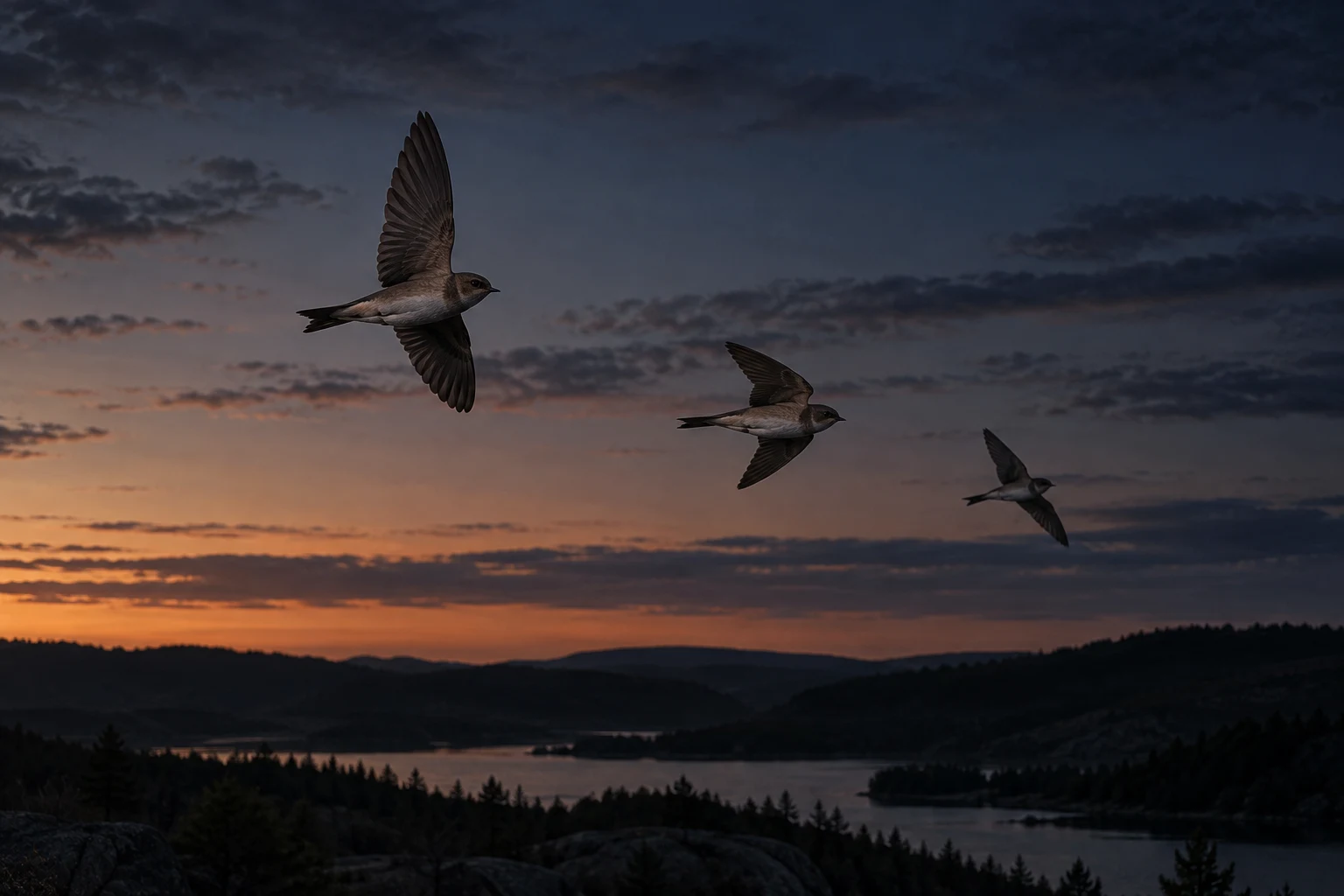
Many birds migrate at night because darkness can provide calmer atmospheric conditions, lower temperatures and less exposure to some daytime predators. For small birds that feed by day, night flight also leaves daylight available for refuelling at stopover sites. Birds do not all use the same strategy: many songbirds migrate after dark, while raptors, swallows, cranes and some waterbirds commonly travel by day. Weather, geography, body size and flight style all influence timing.
On a busy migration night, birds can pass overhead in enormous numbers while people below see almost nothing. Weather radar and flight-call monitoring reveal movements that were once difficult to measure. The darkness is not an accidental setting. For many species, migration has evolved around a daily rhythm in which birds feed and rest on land, then make long flights after sunset.
Which birds commonly migrate at night?
Nocturnal migration is especially common among small landbirds, including many warblers, thrushes and sparrows. Some shorebirds and waterbirds also travel at night, although their schedules vary. A species that is active by day during the breeding season can still become a night migrant for part of the year.
Other birds favour daylight. Raptors often use rising columns of warm air and ridge lift, which develop with daytime heating, to soar while conserving energy. Swallows can feed on flying insects as they travel. Cranes and some large waterbirds may move visibly in daytime groups. Even within one species, the balance between day and night flight can change with route, season, weather or the distance of a particular crossing.
The useful distinction is therefore “many birds”, not “birds”. Migration has multiple solutions.
Does night offer better flying conditions?
Often, but not always. The lower atmosphere commonly becomes more stable after sunset as daytime heating and turbulence decline. Cooler air can also reduce the problem of shedding the heat produced by sustained flight. These conditions may be particularly useful to small birds making powered flights over many hours.
Birds still choose among nights. Wind direction and speed, rain, storms and visibility can affect departure, altitude and progress. A calm-looking evening at ground level does not describe every layer of air above it. Some nights produce major movements because large numbers of birds encounter favourable winds at the same time; others produce little migration.
Night flight is therefore not a guarantee of smooth air. It offers a recurring window that migrants assess alongside weather and their own fuel reserves.
Does migrating at night reduce predation?
It can reduce exposure to many visually hunting daytime predators, one of several plausible advantages of nocturnal travel. Darkness does not make migration safe. Owls and other nocturnal predators may take migrants, and exhausted birds face risks when they land in unfamiliar places.
Predator avoidance is difficult to isolate as the single reason night migration evolved. The same schedule also changes heat balance, atmospheric conditions and access to daylight for feeding. Natural selection can favour a behaviour because several modest advantages work together rather than because one explanation is complete.
Why is daylight valuable to a migrating songbird?
Migration is not only time in the air. Small landbirds often alternate flight nights with stopovers where they rest and rebuild energy reserves. Daylight allows birds that normally forage by sight to search for insects, fruit, seeds or nectar. Flying at night can separate travel time from feeding time.
That does not mean every bird feeds all day and flies every night. Weather, habitat quality, body condition and the next barrier on the route influence whether a bird departs. A bird may remain at a stopover for several days or extend a flight when conditions permit. Some species also make exceptionally long non-stop journeys in which the usual day-night pattern becomes less important.
How can birds navigate in darkness?
Night migrants combine several information sources. Depending on the species and conditions, these can include star patterns, the position and glow of sunset, Earth’s magnetic field, landmarks, wind and inherited directional programmes. Experienced birds may also build route knowledge over repeated migrations.
Darkness does not remove all visual information. Stars and broad landscape features can remain available, and magnetic sensing can provide directional information when landmarks are limited. Birds do not depend on a single compass; different cues can reinforce, calibrate or sometimes conflict with one another.
This question overlaps with navigation but is not the same as it. Nocturnal timing concerns when birds travel; navigation concerns how they maintain or correct direction.
Do night-migrating birds sleep during flight?
The answer differs among species and journeys, and sleep during migration remains an active research area. Some birds can use forms of sleep that are unlike a full night of rest on land, while many small nocturnal migrants must recover sleep during stopovers. It should not be assumed that every bird simply sleeps on the wing.
Migration reshapes the normal daily schedule. Birds may rest during part of the day, take short bouts of sleep and alter their activity as departure approaches. These changes carry costs, which makes safe, food-rich stopover habitat important even when the flight itself happens high overhead.
Why is artificial light dangerous to night migrants?
Artificial light can attract or disorient migrating birds, concentrate them around buildings and increase exposure to glass and other structures. Low cloud, fog and brightly lit sites can worsen the problem. Light does not have to cause an immediate collision to matter; circling or diversion can consume time and energy.
People and organisations can reduce risk by switching off non-essential lights during migration, closing blinds where indoor light escapes through glass, shielding necessary outdoor lighting and directing it downwards. Regional migration tools can help identify high-movement nights where available. Treating reflective or transparent glass remains important because turning lights off does not remove daytime collision risk.
Practical Takeaway
Many small birds use the night as a travel period and daylight as a refuelling period, while benefiting from cooler, often calmer air and reduced exposure to some daytime predators. It is a flexible strategy rather than a universal rule. During migration seasons, reducing unnecessary night lighting and making glass safer can protect birds using this largely unseen aerial route.
Frequently Asked Questions
Do all migratory birds fly at night?
No. Many songbirds migrate at night, but numerous raptors, swallows, cranes and waterbirds commonly migrate in daylight. Some species use both.
Can I hear birds migrating at night?
Sometimes. Many species give short flight calls, especially during migration. Identification from sound requires care because calls can be faint, brief and similar among species.
Do birds migrate every night during the season?
No. Individuals may wait for suitable weather, rebuild energy at a stopover or pause because of their condition or route. Migration intensity can change greatly from one night to the next.
How high do birds fly at night?
Altitude varies with species, terrain, weather, wind and phase of the journey. Radar shows migration across multiple heights, so one universal flight altitude would be misleading.
Should outdoor lights be turned off during migration?
Turn off non-essential lights where safe, especially during locally important migration periods. Necessary lighting should be shielded, directed downward and kept no brighter than required. Local wildlife guidance may provide more specific timing.
Sources
Publisher: Cornell Lab of Ornithology
Title: The Basics of Bird Migration: How, Why, When, and Where
URL: https://www.allaboutbirds.org/news/the-basics-how-why-and-where-of-bird-migration/
Use: Nocturnal and daytime migration patterns, atmospheric conditions, predators, feeding, navigation cues and radar observation. Updated April 2026.
Checked: 25 September 2026
Publisher: BirdCast, Cornell Lab of Ornithology and Colorado State University
Title: Turn Lights Out
URL: https://birdcast.org/lights-out/
Use: Attraction to artificial light, migration forecasts and practical light-reduction measures. The listed migration periods are US-focused and are not presented as universal dates.
Checked: 25 September 2026
Publisher: U.S. Fish and Wildlife Service
Title: Threats to Birds: Collisions — Nighttime Lighting
URL: https://www.fws.gov/story/threats-birds-collisions-nighttime-lighting
Use: Artificial-light attraction, disorientation, collision risk and lighting mitigation; conservation examples are US-specific.
Checked: 25 September 2026
Publisher: Frontiers in Ecology and the Environment
Title: Bright Lights in the Big Cities: Migratory Birds’ Exposure to Artificial Light
URL: https://doi.org/10.1002/fee.2029
Use: Peer-reviewed evidence on nocturnal migrants’ exposure to artificial light and the importance of illuminated urban areas.
Checked: 25 September 2026
Publisher: Convention on the Conservation of Migratory Species of Wild Animals
Title: International Light Pollution Guidelines for Wildlife
URL: https://www.cms.int/sites/default/files/document/2026-05/cms_cop15_res.13.5_rev.cop15_annex_cms-international-light-pollution-guidelines_e_0.pdf
Use: Current international principles for managing artificial light so wildlife can undertake migration and other critical behaviours.
Checked: 25 September 2026
Questions or corrections? Contact Aniluba and include this page’s address.