
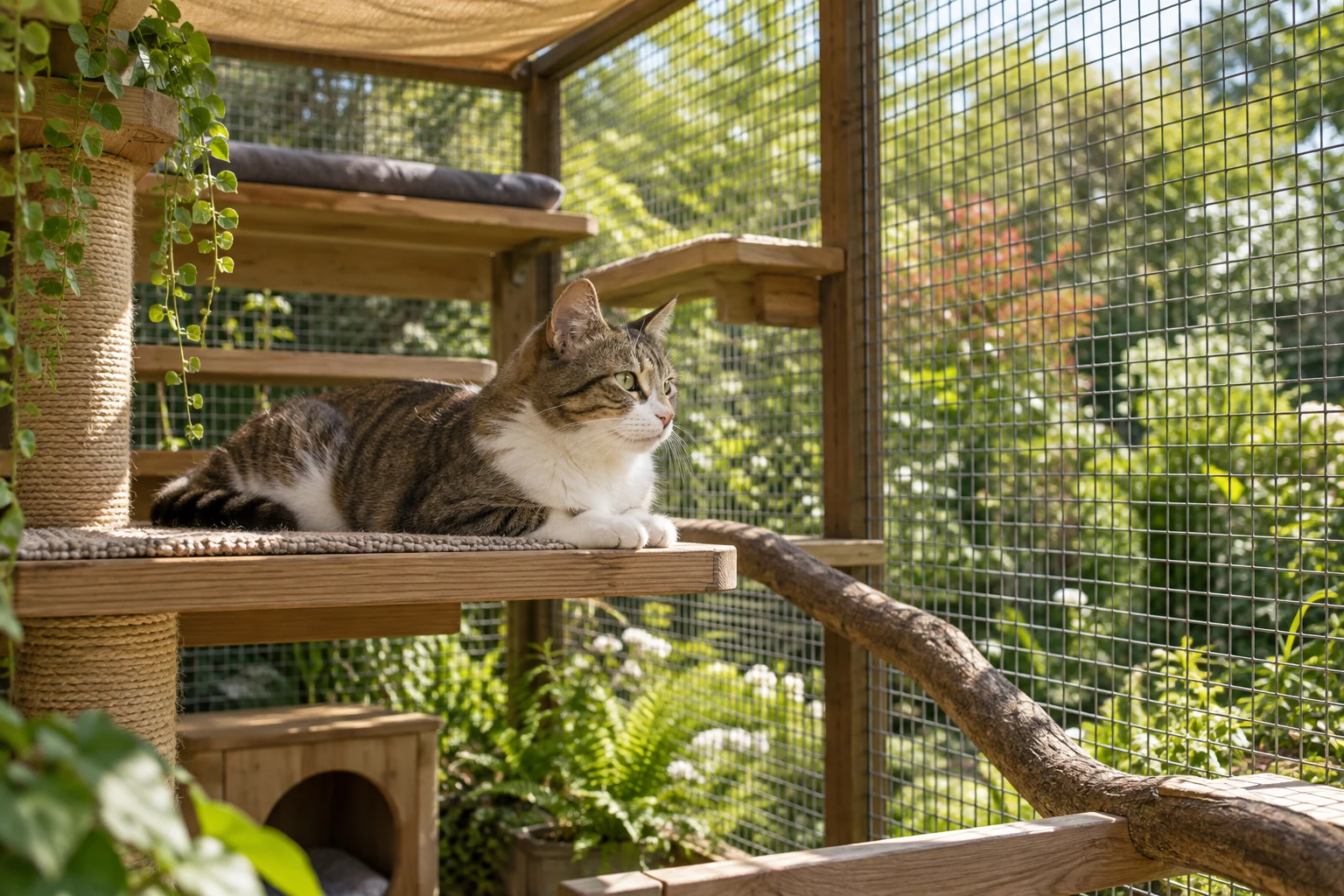
The most reliable way to stop a pet cat hunting wildlife is to prevent unsupervised roaming. Keep the cat indoors with suitable enrichment, use a secure outdoor enclosure, or provide supervised access where appropriate. Regular interactive play and a complete diet support welfare but do not replace containment. Check local laws, use identification, and introduce any lifestyle change gradually with veterinary or qualified behavioural advice when needed.
Hunting is normal feline behaviour, not spite or evidence that a cat is hungry. A well-fed cat may still stalk birds, mammals, reptiles or amphibians. Responsible management therefore has to protect wildlife without punishing the cat for behaving like a cat.
The ecological risk is not identical everywhere. It can be especially serious on islands and near habitats containing vulnerable native species. Local conservation advice should guide the level of precaution.
Why do pet cats hunt when they are fed?
Hunting is driven by behavioural motivation as well as hunger. Movement, sound and the opportunity to stalk can trigger a hunting sequence even after a meal. Feeding more food is therefore not a dependable wildlife-protection measure and can create obesity.
Provide safe outlets for searching, chasing and pouncing, but assume that a free-roaming cat may still hunt. Some captured animals are eaten; others are brought home or left where the owner never sees them.
Is keeping a cat indoors the best protection for wildlife?
Preventing unsupervised access to wildlife is the clearest protection. Options include an indoor lifestyle, a secure catio or enclosed garden, and supervised harness access for cats who tolerate it.
Indoor or contained living must still meet the cat’s needs. Provide vertical space, hiding places, scratching surfaces, clean litter trays, play, foraging opportunities, resting sites and predictable social contact. Windows and screened outdoor areas can offer safe sensory interest.
Some cats adapt readily; others with a long history of roaming may show frustration if confined abruptly. Make changes gradually, improve the indoor environment before restricting access and ask a veterinarian or qualified cat behaviour professional for help if welfare problems develop.
Is a night-time curfew enough?
Keeping cats in at night can reduce access during an active hunting period and may be required by local rules. It does not eliminate daytime predation. Birds, lizards and other animals may be vulnerable in daylight, particularly during nesting or fledging seasons.
If complete containment is not immediately possible, a curfew is a useful step while a secure long-term arrangement is developed. Check municipal and national rules: cat containment, registration, microchipping and access to protected areas differ substantially among jurisdictions.
Do bells and colourful collar covers work?
Some studies have found reductions in prey returned home when cats wore bells or brightly coloured collar covers. Results vary by prey type, product, cat and study design. These devices reduce risk; they do not make roaming harmless.
Any collar must be designed for feline safety, correctly fitted and checked often. A quick-release mechanism can reduce snagging risk, although no collar is risk-free. Some welfare organisations advise against collars in particular circumstances, so discuss the individual cat with a veterinarian.
Never use a collar device that restricts breathing, movement, hearing or normal grooming. Collar accessories are a secondary measure, not a substitute for secure containment.
Can play and diet reduce hunting?
A controlled trial published in Current Biology found that daily object play and a high-meat-protein, grain-free food were associated with fewer prey animals being brought home by participating cats. The result does not prove that a particular commercial diet prevents hunting, and it should not be used to prescribe an unsuitable diet.
Use several short interactive play sessions with wand-style toys that allow stalking, chasing and pouncing. Let the cat catch the toy, then end calmly. Food puzzles and scattered portions of the cat’s normal ration can add searching behaviour.
Choose a complete, balanced diet appropriate to the cat’s age and health with veterinary guidance. Do not overfeed, use raw meat as a wildlife intervention or change a medical diet without professional advice.
How can I make outdoor access safer?
A secure enclosure should prevent escape, entry by other animals and contact with hazardous plants or chemicals. Include shade, water, weather protection, elevated resting places and routes that do not force cats past one another in multi-cat homes.
Harness walks suit some cats but distress others. Introduce a properly fitted harness indoors with rewards and stop if the cat freezes, struggles or shows sustained fear. Never tether a cat unattended.
Supervision must be genuine. Watching from a window after the cat has disappeared into vegetation does not prevent hunting.
What else should responsible cat owners do?
Neutering can reduce breeding and some roaming behaviour, but it does not reliably remove hunting motivation. Microchipping and any locally required identification help reunite lost cats with guardians. Routine veterinary care and parasite prevention protect the cat and may reduce disease risks linked to roaming.
Do not place bird feeders where a cat can hide nearby and ambush feeding animals. Keep cats away from nests, fledglings, ponds, rock walls and other concentrated wildlife areas. If your cat catches an animal, separate the cat, keep the wildlife safe from further contact and seek advice from an authorised wildlife rehabilitator. Cat-caught animals may have serious injuries that are not visible.
Should community cats be handled differently?
Unowned, stray and unsocialised cats raise different legal, welfare and ecological questions from an owned pet. Do not trap, relocate, poison or abandon cats yourself. Contact the appropriate local authority or experienced animal-welfare organisation for lawful, humane guidance.
Management approaches vary by country and habitat. A method used in one city may be prohibited or ecologically unsuitable elsewhere, especially near sensitive wildlife populations.
Practical Takeaway
Use secure containment or supervised access as the foundation. Make the home interesting before restricting a roaming cat, schedule daily interactive play, provide a suitable complete diet and keep identification current. Treat bells or colourful collar covers only as additional risk reduction. Check local law and local conservation advice, particularly near protected or vulnerable wildlife.
Frequently Asked Questions
Does feeding my cat more stop hunting?
No. Hunting is not controlled by hunger alone, and overfeeding can harm health. Provide a balanced diet and safe opportunities to perform hunting-like play.
Will a bell stop my cat catching birds?
A bell may reduce some captures, but it will not prevent all predation and may work differently for birds and small mammals. Use only an appropriate safety collar and combine it with restricted roaming.
Is it cruel to keep a cat indoors?
Indoor living can support good welfare when the environment provides space, choice, climbing, hiding, scratching, play, clean resources and social contact. Individual cats may need a gradual transition and professional support.
Do cats mainly hunt at night?
Cats may hunt at night, dawn, dusk or during the day. A night-time curfew can reduce risk but does not protect daytime wildlife completely.
Does neutering stop cats hunting?
Not reliably. Neutering is important for population management and can reduce some roaming or mating behaviour, but hunting motivation can remain.
What should I do if my cat catches a wild animal?
Remove the cat, avoid unnecessary handling and contact an authorised wildlife rehabilitator or veterinarian promptly. Do not feed, medicate or attempt home rehabilitation.
Sources
Organisation / publisher: American Association of Feline Practitioners and International Society of Feline Medicine
Title: AAFP and ISFM Feline Environmental Needs Guidelines
URL: https://journals.sagepub.com/doi/10.1177/1098612X13477537
Use: Meeting feline environmental and behavioural needs when cats live indoors or with controlled access.
Checked: 11 September 2026
Organisation / publisher: Cecchetti et al., Current Biology
Title: Provision of High Meat Content Food and Object Play Reduce Predation of Wild Animals by Domestic Cats Felis catus
URL: https://doi.org/10.1016/j.cub.2020.12.044
Use: Evidence on daily object play, diet and prey returned home; interpreted as risk reduction rather than complete prevention.
Checked: 11 September 2026
Organisation / publisher: Loss, Will and Marra, Nature Communications
Title: The Impact of Free-Ranging Domestic Cats on Wildlife of the United States
URL: https://doi.org/10.1038/ncomms2380
Use: Evidence that free-ranging owned and unowned cats can cause substantial wildlife mortality; US estimates were not presented as global figures.
Checked: 11 September 2026
Organisation / publisher: Scottish Animal Welfare Commission
Title: Responsible Domestic Cat Ownership
URL: https://www.gov.scot/publications/scottish-animal-welfare-commission-report-responsible-domestic-cat-ownership/
Use: Balancing cat welfare, responsible ownership, wildlife concerns and locally proportionate management.
Checked: 11 September 2026
Organisation / publisher: New Zealand Ministry for Primary Industries
Title: Code of Welfare: Companion Cats
URL: https://www.mpi.govt.nz/animals/animal-welfare/codes/all-animal-welfare-codes/code-of-welfare-companion-cats/
Use: Responsible cat care, identification, health, behavioural needs and New Zealand-specific welfare context.
Checked: 11 September 2026
Questions or corrections? Contact Aniluba and include this page’s address.