
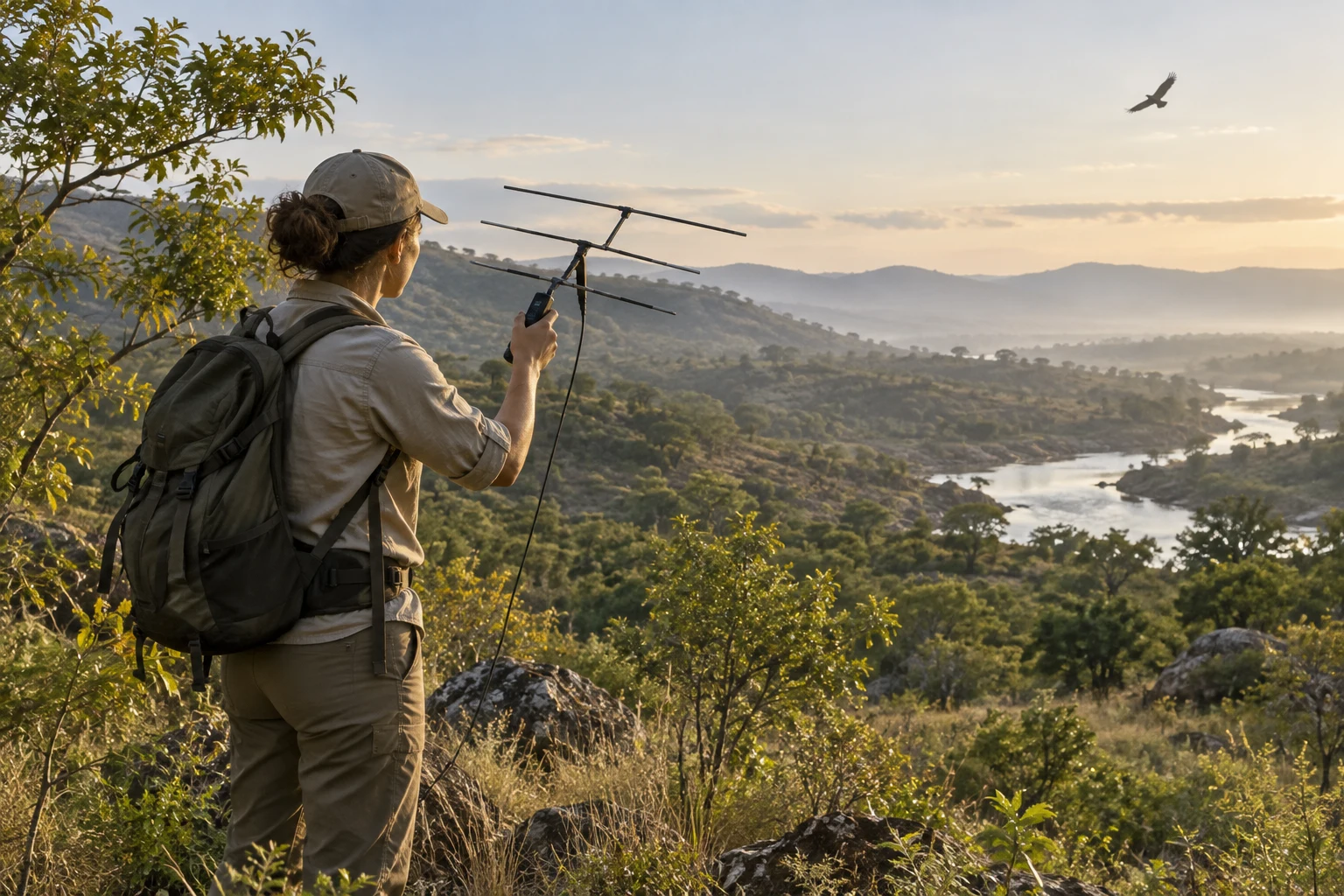
Post-release monitoring follows selected rehabilitated animals after they return to the wild to assess survival, movement, behaviour, habitat use and, where relevant, reproduction. Authorised teams may use visual identification, bands, tags, radio or satellite telemetry, camera traps and verified public reports. A useful programme defines its questions before release, protects animal welfare and interprets missing data cautiously: a lost signal is not automatically a death.
Release is an important milestone, but it is not proof that rehabilitation succeeded. Monitoring can reveal whether an animal survives, feeds and moves normally, avoids harmful human contact and integrates into suitable habitat. It can also expose problems with release timing, location, preparation or equipment.
What questions should monitoring answer?
A programme should decide before release what evidence would change practice. Common questions include:
- Did the animal survive the early adjustment period and longer term?
- Did it remain in suitable habitat or leave the release area?
- Could it forage, shelter, navigate and behave in ways expected for its species?
- Did it become dependent on people, enter conflict or require intervention?
- Did rehabilitation or release methods appear to affect the outcome?
- For conservation releases, did the animal reproduce or contribute to population goals?
Not every case needs the same measures. A short welfare check after releasing a common bird has different aims from multi-year monitoring of an endangered, long-lived mammal. The IUCN advises that monitoring be designed around explicit objectives and continue for a period appropriate to the organism and the programme’s timescale.
Which monitoring methods may be used?
Visual identification and field observation
Natural markings, photographs or planned observation can identify some animals without a carried device. Observers may record location, condition and behaviour, but repeated visits can disturb wildlife. Failure to see an animal means only that it was not detected.
Bands, rings, tags and passive identifiers
Bands, flipper tags and other unique marks can link a later sighting or recovery to the release record. Passive transponders identify an animal near a reader but do not broadcast continuously. These methods depend on detection; marks can wear, detach or go unreported.
VHF, GPS and satellite telemetry
VHF transmitters are located by receivers; GPS or satellite devices can store or send positions. They may reveal movement and habitat use, but signals can be blocked, batteries fail and attachments detach. A stationary signal may reflect mortality, device loss or inactivity and requires professional investigation.
Camera traps, acoustic tools and environmental evidence
Remote cameras, acoustic recorders, tracks, nests or genetic samples can add evidence, although linking them to one released animal may be difficult.
Combining methods often produces a stronger picture than relying on one stream of data.
How are animal welfare and permits protected?
Capture, marking and tracking are professional activities. They may require wildlife, research, ethics, land-access and data permissions that differ between jurisdictions and species. A member of the public should not attach a device, remove a tag, recapture an animal or begin following it closely.
Any carried device can impose weight, drag, skin contact, entanglement or behavioural costs. The 2025 wildlife-biology framework on animal-borne devices argues that rehabilitated animals become research subjects when used in a monitoring study, so welfare must be considered during design and review. Teams should justify why a device is needed, choose the least burdensome method that can answer the question, test attachments, define removal or intervention criteria and plan for device failure.
The relevant comparison is not “data or no data.” It is whether the expected knowledge and welfare benefit justify the method’s risks for that species and individual.
What makes a monitoring plan scientifically useful?
A useful plan records the animal’s identity, reason for admission, condition, care, release criteria, site, timing and monitoring method consistently. It defines:
- the outcome measures and observation period;
- how often and where teams will search;
- what counts as survival, dispersal, loss of contact or confirmed mortality;
- how equipment failure and missed detection will be handled;
- whether an appropriate wild or non-rehabilitated comparison group is feasible;
- who reviews welfare concerns and decides on intervention;
- how findings will be analysed and reported, including unfavourable outcomes.
Without these details, a series of sightings may be encouraging but cannot reliably compare techniques or predict success for other animals.
The 2022 systematic review by Cope and colleagues found that wildlife survival evidence was strongly species- and context-dependent and that relatively few studies included control groups. A 2025 global review also found substantial weaknesses in methodological rigour and reporting. These findings support careful, transparent interpretation rather than universal survival claims.
What does a lost signal mean?
A lost signal is unresolved. The animal may have moved beyond the search area, entered terrain that blocks transmission, lost the device, experienced equipment failure or died. An animal may also be alive but unseen. Good monitoring distinguishes “not detected” from “confirmed dead” and a single sighting from demonstrated longer-term survival.
When might professionals intervene after release?
Release should not become routine recapture. Teams define intervention criteria around permits, welfare and public safety; possible triggers include verified injury, inability to forage, dangerous human habituation or an equipment problem. Because recapture has risks, the public should contact the responsible authority rather than attempting it.
How do monitoring results improve rehabilitation?
Results can test whether husbandry, conditioning, release timing, site selection or support need improvement. They may also reveal threats such as roads, fishing gear, free-roaming domestic animals or unsuitable habitat. Negative and uncertain findings still matter: they can improve equipment, search design and future protocols. Monitoring earns its value when evidence returns to decisions.
What should the public do if they see a marked animal?
Observe from a respectful distance. Do not chase, feed, touch or change the animal’s route to obtain a photograph. Record the date, time, location and tag or band code only if these can be seen without disturbance. Use the reporting details on the marker or contact the responsible wildlife authority or rehabilitation organisation.
Do not post the precise location of a sensitive species publicly. Location data can expose animals to harassment, collection or disturbance. Follow the project’s reporting channel instead.
If the animal appears injured, trapped or in immediate danger, contact authorised local wildlife help. A tag or transmitter is not, by itself, evidence that the animal needs rescue.
Practical Takeaway
Post-release monitoring asks whether rehabilitation led to a viable return to the wild. Strong programmes define questions first, choose a proportionate method, protect animal welfare, record detection limits and feed the results back into practice. The public can help by reporting marked animals through official channels without approaching, feeding, capturing or publicly sharing sensitive locations.
Frequently Asked Questions
Is every rehabilitated wild animal tracked after release?
No. Tracking may be impractical, unnecessary, unauthorised or too burdensome. Programmes prioritise cases in which monitoring can answer an important welfare, rehabilitation or conservation question.
Does a transmitter show everything an animal is doing?
No. It may show positions, movement or activity proxies, depending on the device. It does not automatically reveal feeding success, health or subjective welfare.
Does a mortality signal prove the animal has died?
Not by itself. It may indicate prolonged inactivity, device detachment or failure. Trained teams investigate according to their protocol.
Can I remove a loose-looking tag from wildlife?
No. Keep your distance and report the observation to the organisation or authority named on the marker. Handling wildlife and altering authorised equipment can harm the animal and may be unlawful.
How long does post-release monitoring last?
It depends on the question, species, expected adjustment period, device life, permits and resources. A valid plan states why its chosen duration is sufficient and acknowledges what remains unknown.
Sources
Source 1
Organisation / publisher: International Union for Conservation of Nature, Species Survival Commission
Title: Guidelines for Reintroductions and Other Conservation Translocations
URL: https://iucn.org/resources/publication/guidelines-reintroductions-and-other-conservation-translocations
Use: Objective-led monitoring, appropriate duration, adaptive management and the role of post-release evidence in judging translocation outcomes. Conservation-translocation guidance was applied as a framework, not presented as a legal rule for every rehabilitation release.
Checked: 5 October 2026
Source 2
Organisation / publisher: Harvey-Carroll et al., Wildlife Biology
Title: A Framework for the Ethical Use of Animal-Borne Devices in Post-Release Monitoring Following Rehabilitation
URL: https://nsojournals.onlinelibrary.wiley.com/doi/full/10.1002/wlb3.01404
Use: Welfare risks of animal-borne devices, research-subject status, ethical design, the four-R approach and the range from simple marking to telemetry.
Checked: 5 October 2026
Source 3
Organisation / publisher: Cope et al., PLOS ONE
Title: A Systematic Review of Factors Affecting Wildlife Survival During Rehabilitation and Release
URL: https://journals.plos.org/plosone/article?id=10.1371/journal.pone.0265514
Use: Species- and context-specific survival evidence, value of consistent outcomes, limited use of control groups and the need for evidence-based release protocols.
Checked: 5 October 2026
Source 4
Organisation / publisher: Massie et al., Veterinary Quarterly
Title: Methodological Rigour and Reporting Quality of the Literature on Wildlife Rescue, Rehabilitation, and Release: A Global Systematic Review
URL: https://pmc.ncbi.nlm.nih.gov/articles/PMC11980188/
Use: Recent evidence on weaknesses in study design, reporting and replicability, supporting cautious interpretation and better data standards.
Checked: 5 October 2026
Source 5
Organisation / publisher: U.S. Geological Survey
Title: Tagging and Tracking
URL: https://pubs.usgs.gov/publication/70198563
Use: Post-release monitoring of rehabilitated marine mammals, purposes of tagging and tracking, assessing foraging, survival and reproduction, and the jurisdiction-specific US framework.
Checked: 5 October 2026
Source 6
Organisation / publisher: U.S. Fish and Wildlife Service
Title: Bird Banding: A Conservation Tool Within the Migratory Bird Program
URL: https://www.fws.gov/project/bird-banding-conservation-tool-within-migratory-bird-program-ducks-geese-doves-and-more
Use: How unique bands, recaptures, recoveries and public reports contribute information on distribution, movement, survival and reproduction. Reporting instructions were identified as US-specific.
Checked: 5 October 2026
Questions or corrections? Contact Aniluba and include this page’s address.